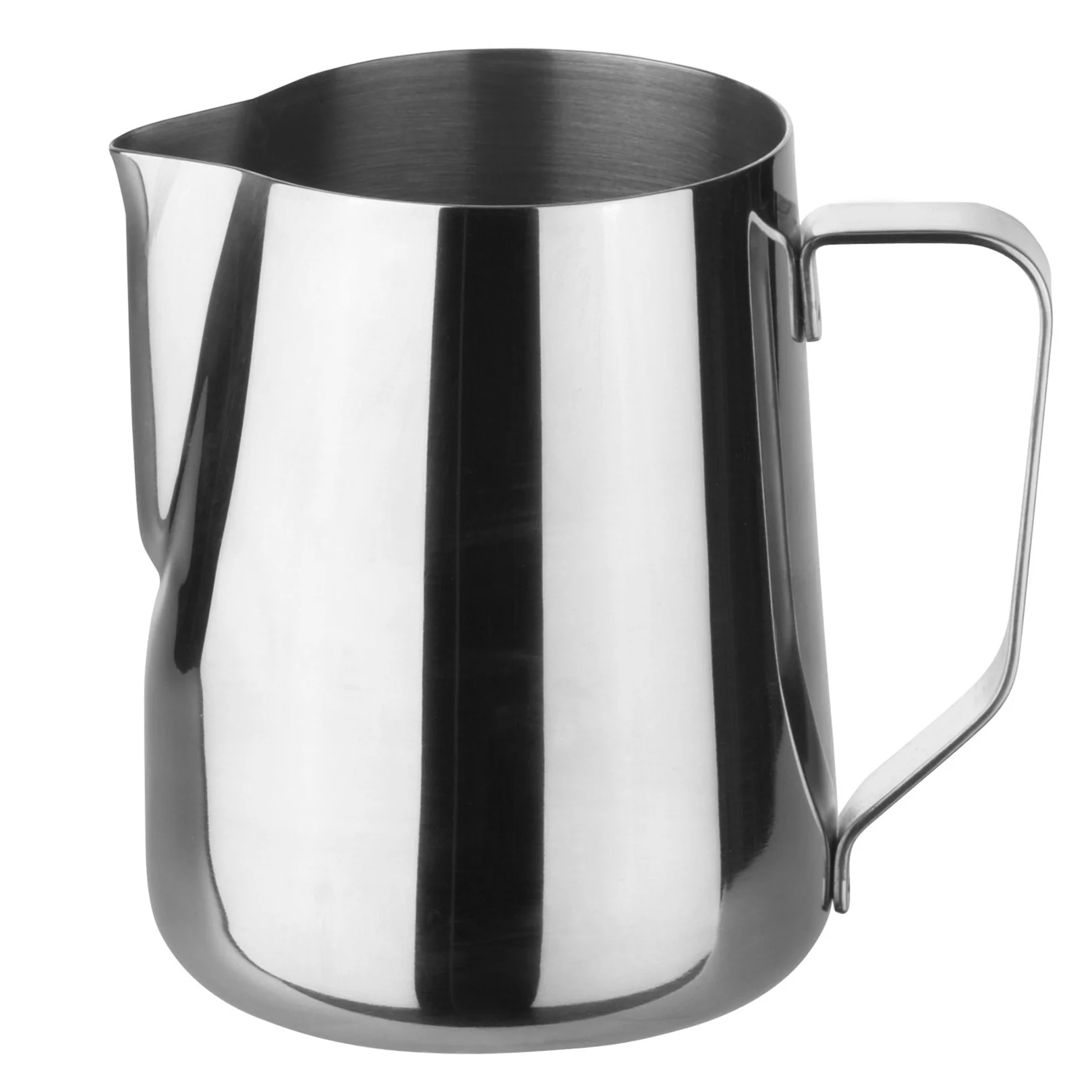




JoeFrex Stainless Steel Milk Pitcher: The Classic for Perfect Microfoam and Latte Art
- Suitable for latte art
- Dishwasher safe
- Helps create fine, even microfoam when frothing milk
- Thick-walled stainless steel
Our 350 ml JoeFrex stainless steel milk pitcher is a barista tool developed by us for preparing coffee specialties such as cappuccino – bringing a little taste of Italy into your home. We have been selling milk pitchers for frothing milk for almost 15 years and have always supplied both enthusiastic home coffee lovers and professional baristas and cafés.
For many of our customers, our milk pitchers have become an essential part of their barista equipment. After all, perfectly textured milk foam is essential for a genuine Italian-style cappuccino.
Durable Stainless Steel for Everyday Use
We manufacture our milk pitchers exclusively from durable stainless steel. This is not only because of its classic, timeless appearance, but also because of its excellent functionality.
Stainless steel milk pitchers are extremely robust and designed for long-lasting use. At the same time, their timeless design makes them a perfect addition to any coffee bar, espresso machine setup or home barista corner.
Milk Pitcher, Milk Jug or Milk Frothing Pitcher?
Milk pitchers are also commonly referred to as milk jugs or milk frothing pitchers. They are used in cafés and coffee bars as well as in many homes.
From mixing salad dressings to serving cream, we have seen our milk pitchers used for many different purposes. However, their main purpose naturally remains frothing milk for cappuccinos, latte macchiatos and other milk-based coffee drinks.
The Classic Milk Pitcher for Latte Art
Over the years, we have developed other milk pitchers with spouts that are even more specifically designed for latte art. Nevertheless, our standard model remains a popular choice among professional baristas for creating beautiful latte art in cappuccinos.
The classic design combines a precise pouring spout with excellent functionality.
We offer our milk pitchers in a wide range of sizes because choosing the right size and ergonomic shape is an important part of creating perfect microfoam. The 350 ml milk pitcher, for example, is ideal for preparing one cappuccino.
Choose your milk pitcher according to the amount of milk you normally use to create consistently excellent microfoam.
Easy to Clean
Cleaning the milk pitcher is extremely easy. Its smooth surface makes rinsing it under running water simple and convenient.
The pitcher is also dishwasher safe, allowing it to be cleaned hygienically and easily. This makes it a popular and valued part of any espresso setup and barista equipment.
Our goal is to make it easy for anyone to produce beautiful, silky-smooth microfoam with our stainless steel milk pitcher and prepare and enjoy coffee like a professional barista.
Laser Engraving Service
This product can be personalized with your company logo or a custom design on request. Ideal for cafés, coffee roasters, hotels, businesses and promotional gifts.
Learn more about our laser engraving service.
Frequently Asked Questions About Milk Pitchers
1. What Size Milk Pitcher Should I Use?
Choose a milk pitcher that is slightly larger rather than too small.
Ideally, cold milk should fill only about one third of the pitcher. This leaves enough room for the milk to increase in volume during frothing, circulate freely during the rolling phase and then be swirled to create a smooth, homogeneous microfoam.
The following table shows which pitcher size we recommend depending on your cup size.
| Small Italian Cappuccino | German Cappuccino | Large Cappuccino | |
|---|---|---|---|
| Cup size | approx. 150 ml | approx. 200 ml | approx. 300 ml |
| Cold milk | approx. 90–100 ml | approx. 120–140 ml | approx. 180–200 ml |
| Recommended pitcher | 350 ml | 350 ml | 590 ml |
2. How Full Should a Milk Pitcher Be?
We recommend filling the milk pitcher with cold milk to no more than about one third full.
This leaves enough space for the milk to expand during frothing, allows for a good rolling motion and gives you enough room to swirl the milk afterwards to create smooth, homogeneous microfoam.
When in doubt, choose a slightly larger pitcher rather than a smaller one.
Material Tip: Uncoated Stainless Steel
We recommend milk pitchers made from uncoated stainless steel.
Exterior coatings can become scratched over time or wear off through frequent washing, particularly in powerful commercial dishwashers. The pitcher can then quickly start to look worn.
Uncoated stainless steel can also develop scratches and signs of use during everyday operation, but these tend to develop into an even, natural patina over time.
We also deliberately avoid an interior coating.
Interior coatings can become damaged or wear off through regular use, cleaning and mechanical stress. Since the inside of the pitcher comes directly into contact with the milk, we prefer to avoid the possibility of coating components coming loose and entering the milk.
3. Why Is the Shape of the Pouring Spout Important for Latte Art?
The shape of the pouring spout affects how precisely you can control the milk stream when pouring.
As a general rule, the finer and narrower the spout, the easier it is to pour very fine lines and detailed latte art designs.
For simple and classic designs such as hearts, tulips and rosettas, however, all of our milk pitchers are suitable.
A particularly sharp, wider or more forward-angled spout is not necessarily better or worse. Much depends on the barista’s individual pouring technique and personal preferences.
As their skills develop, most baristas eventually develop a preferred pitcher and spout shape.
Our tip: When starting out, the exact shape of the spout is less important than producing good, homogeneous microfoam and developing controlled pouring technique. For particularly detailed latte art, a finer spout can provide advantages later on.
4. Thick-Walled or Thin-Walled – Which Milk Pitcher Is Better?
Both have their advantages.
Thin-walled milk pitchers respond more quickly to temperature changes. By touching the pitcher with your hand, you can therefore get a good sense of how warm the milk has become and when to stop steaming.
Thicker-walled pitchers heat up more slowly and retain heat for longer. They often feel more solid and stable, although the actual milk temperature is slightly harder to sense through the outside wall.
For frothing itself, the wall thickness is not decisive for microfoam quality.
The position of the steam wand, the stretching and rolling phases, and the temperature are much more important.
Which wall thickness feels more comfortable is therefore also a matter of personal preference.
5. Coated or Uncoated – Which Milk Pitcher Is Better?
We generally recommend milk pitchers made from uncoated stainless steel.
They are robust, durable and particularly well suited to everyday use in professional cafés and restaurants.
Stainless steel can develop scratches and signs of use over time, but these tend to become part of a natural patina.
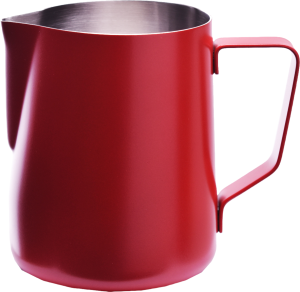
Coated milk pitchers mainly offer aesthetic advantages.
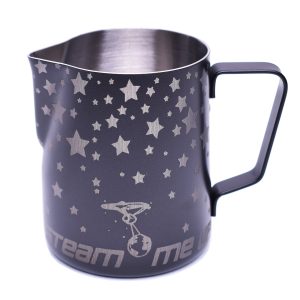
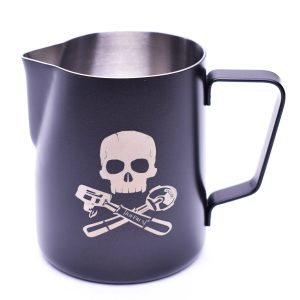
Different colors and finishes can be chosen to match the espresso machine, interior design or style of a coffee bar.
However, coatings can become scratched over time or wear off through frequent washing, particularly in commercial dishwashers.
We deliberately avoid an interior coating.
The inside of the pitcher comes directly into contact with milk. A coating can become damaged through use and cleaning and may potentially come loose. With a pitcher made from bare stainless steel, this issue does not arise.
Colors, engravings and labels can also have a practical purpose.
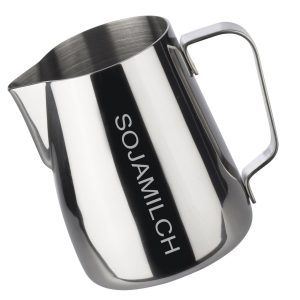
For example, pitchers labeled “Lactose-Free,” “Oat” or “Soy” allow baristas to immediately identify which pitcher should be used for which type of milk. This makes organization easier, particularly during busy café service, and helps prevent mix-ups.
A laser-engraved logo is also durable and turns a simple stainless steel milk pitcher into a personalized professional tool without requiring an interior coating.
→ Learn more about our laser engraving service
6. Do I Need a Measurement Scale in a Milk Pitcher?
A measurement scale is not essential, but it is very useful for consistently measuring milk.
It makes portioning easier, reduces unnecessary milk waste and helps you work with the same starting quantity for every cappuccino.
Especially in professional cafés, this can save milk, time and money over the long term.
If you can reliably estimate the amount you need by eye, however, you can easily work without a scale.
→ Shop milk pitchers with measurement scale
7. How Hot Should Milk Be When Frothing?
For creamy microfoam, the milk should reach approximately 60–65 °C (140–149 °F) at the end of the steaming process.
Significantly higher temperatures should be avoided because they can negatively affect both flavor and foam texture.
The hand method works surprisingly well.
Place one hand on the pitcher while steaming. With a little practice, you quickly develop a feel for the right temperature and no longer need a thermometer in everyday use.
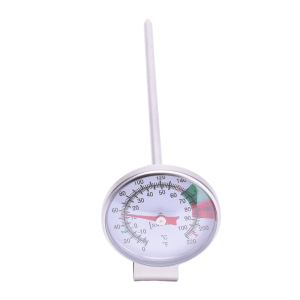
When practicing and learning what 60–65 °C feels like, however, a thermometer can be very helpful.
After a few attempts, you will usually be able to tell from the temperature of the pitcher when it is time to stop steaming.
8. Which Milk Is Best for Frothing?
In principle, many different types of milk can be frothed successfully.
Cow’s milk with a standard fat content is particularly easy to work with for beginners and usually produces creamy, stable microfoam.
The protein content is especially important for foam formation, while fat has a greater influence on flavor, mouthfeel and creaminess.
Oat, soy and other plant-based drinks can also work very well. However, there are greater differences between individual products.
Special barista versions are usually formulated to make frothing easier and produce more stable microfoam.
Regardless of the type of milk you use, it is best to start with well-chilled milk.
This gives you more time for the stretching and rolling phases and makes the foam easier to control.
9. Can I Froth Milk Again After It Has Already Been Frothed?
Yes, as long as the milk was not overheated during the first steaming process.
Leftover milk can be combined with fresh, cold milk and frothed again.
However, if the milk has already been heated too much, it should not be frothed again. Overheated milk will no longer produce good microfoam a second time.
Our tip: Only froth as much milk as you actually need. This reduces milk waste and helps maintain consistently good foam quality.
Overheated milk does not necessarily have to be thrown away. Although it is no longer ideal for frothing again, it can still be used, for example, in a latte macchiato, café au lait or another milk-based drink, provided it is handled hygienically and used promptly.
10. Why Do Cafés Use Different Milk Pitchers for Different Types of Milk?
Cafés often use separate milk pitchers for cow’s milk, lactose-free milk and plant-based alternatives such as oat or soy drinks.
This helps prevent mix-ups and makes workflow around the espresso machine easier and more organized.
Different-colored or permanently labeled pitchers are particularly practical. Labels such as “Lactose-Free,” “Oat” or “Soy” allow the barista to identify the correct pitcher immediately, even during busy service.
→ Shop lactose-free milk pitchers
Important: For allergies, labeling alone is not sufficient. Appropriate hygiene and allergen procedures must also be followed, and cross-contact must be avoided.